Oxford, The City of Dreaming Spires, is famous all over the world for its University and place in history. For over 800 years, it has been a home to royalty and scholars, and since the 9th century an established town, although people are known to have lived in the area for thousands of years.
Oxford and Oxfordshire make an excellent destination ... Explore Oxfordshire’s varied landscape, visitor attractions and rural heritage or experience walking trails and cycling routes which show you all the hidden treasures here.
Renowned for its history and heritage, exquisite architecture, and ancient University, Oxford sits at the very heart of this rural county.
It’s easy to visit Oxfordshire; Oxford is just 50 minutes from central London by train or 90 minutes by frequent bus services. Once here, you can visit much of Oxfordshire by public transport including many of the county’s picturesque townsand villages.
Cambridge is located about 60 miles (100 Km) from London. Its university was founded in the twelfth century by disaffected academics from Oxford University. The oldest building from that time is in St John’s College but the oldest surviving college is Peterhouse. Cambridge and Oxford are similar distances from London: Oxford lies to the west and Cambridge to the north.
Cambridge a city for all seasons...
Be inspired by the many beautiful museums and art galleries. Admire the beautiful architecture and majestic college buildings.
Explore quaint passages set around the historic market place and colleges, where a unique and relaxing shopping experience can be found. Here a blend of independent shops is mingled with high street brands.
Relax in the many beautiful pubs, restaurants and cafes....
Click here to learn vocabulary and useful questions and expressions.
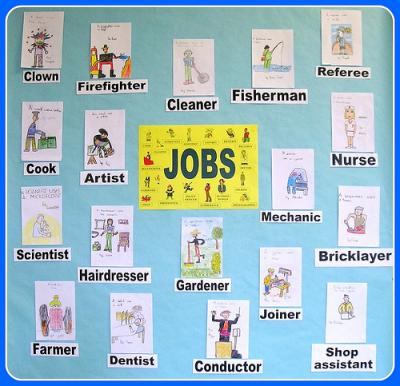
This is a crossword. Click here to do a reading comprehension exercise about a job interview. This is a vocabulary test.This is another vocabulary activity (you have to solve the randomly scrambled letters of the words/phrases (all from jobs )).Finally, click here and here to watch videos.
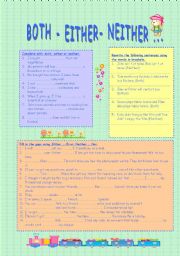
Subjects connected by ’both … and’ take the a plural conjugation.
Examples:
Both Alice and Janice attended USC. Both Jim and Peter are attending the conference in New York this weekend.
Either … or
’Either … or’ is used in sentences in a positive sense meaning "one or the other, this or that, he or she, etc." Verb conjugation depends on the subject (singular or plural) closest to the conjugated verb.
Examples:
Either Peter or the girls need to attend the course. (second subject plural) Either Jane or Matt is going to visit next weekend. (second subject singular)
Neither … nor
’Neither … nor’ is used in sentences in a negative sense meaning "not this one nor the other, not this nor that, not he nor she, etc.". Verb conjugation depends on the subject (singular or plural) closest to the conjugated verb.
Examples:
Neither Frank nor Lilly lives in Eugene. (second subject singular) Neither Axel nor my other friends care about their future. (second subject plural)
The Lost Thing is an amazing picture book by the wonderful artist Shaun Tan which has recently become a beautiful short film (click here as well). Have you ever felt as if you were some kind of weirdo? If your answer is "yes", it won’t be hard for you to understand what the short film above is about. Enjoy it!!!!!!
Click HERE for a fill-in-the-gaps exercise. Click HERE as well.
This is the first documentary BBC Human Planet has broadcast this season. What a risky job!!! Daredevil Galician barnacle-collectors defy death on the rocks for a catch worth 200 pounds per kilo.
Grammar, Vocabulary, graded listening comprehension activities, exercises (quizzes, vocabulary, readings...), Rick Mansworth's adventures (Here you follow the exciting adventures of Rick Mansworth, Private Detective as he fights evil and saves the world. Each episode practises a different aspect of the language), books, videos(in their youtube channel).......
Wlingua is an excellent English course. Improve your grammar, listening, reading comprehension, vocabulary, phonetics... (Click here). You can do the test, find out what your level is... and start your lessons. Try it!!
Learning Chocolate is a great webpage that allows students to learn vocabulary easily. They use pictures, sounds, games... If you think that memorizing English vocabulary is too hard, try this page and you will change your mind.
Thank you very much for sharing this fantastic page with us, Wilson.
The electronic European Language Portfolio, the e-ELP, is a document based on the guidelines of the Council of Europe specified in the Common European Framework of Reference for Languages and intended to be used for pedagogical and informative purposes: - It is pedagogical because it should help you plan your learning, visualize your progress and discern which methodology suits you best, thus potentiating your autonomy as a language learner and motivating you to continue learning languages throughout your life. - It is informative, because thanks to the language passport and the dossier, you can demonstrate your knowledge of languages and provide clear and comprehensible information on your level of competence, learning profile and use of languages anywhere in Europe.
Through the e-ELP website you may also create and manage your e-ELP for the language you select. This tool allows you to access and keep your Portfolio updated from anywhere in the world. This will help you to develop critical awareness and plan your learning more easily.
The e-ELP is divided into the same three parts as the European Language Portfolio: Language Biography ( The Language Biography helps learners to plan, reflect on and assess their progress), Dossier (The Dossier is for storing evidence of the language skills, acquired both formally and informally, which have been recorded in the biography or passport)and Language Passport (The Passport section provides a summary of learners’ proficiency in different languages and is linked to the common reference levels in the CEF. Learners record their formal qualifications and language and intercultural skills, experiences and achievements. There is also a grid for self assessment).