This cartoon by Brighty from The Sun is a comment on the the fact that watching TV is not as popular as it used to be, especially at Christmas time. A man suggests watching telly (ie, watching TV or watching the television), but the rest of his family are more interested in other types of screen: the grandmother is using an iPad, the son a laptop, and his wife (or daughter?) a mobile phone.
When never, rarely, little etc. are placed at the beginning of the sentence for rhetorical effect, the subject and auxiliary are inverted:
Never (before) have we faced such a challenge! (We have never faced such a challenge!)
Rarely has there been so much speculation about the future of the company. (There has rarely been so much speculation about the future of the company.)
Little did she understand what the conversation was about. (She didn’t really understand what the conversation was about.)
Under no circumstances are you allowed to disturb the pilots. (You are not allowed to disturb the pilots under any circumstances.)
On no condition will the company bear responsibility for lost property. (The company will not bear responsibility for lost property on any condition.)
In no way am I related to the suspect. (I am in no way related to the suspect. )
Not only did he exceed the speed limit, but he had also consumed alcohol. (He not only exceeded the speed limit but he had also consumed alcohol.)
Not only were you late, but you didn’t even have a good excuse. (You were not only late, but you didn’t have a good excuse either.)
We can use inversion in certain types of conditional sentences when the if-clause begins with had, were or should. Sentences with inversion sometimes sound more formal than those with the more conventional if-construction. Compare the following:
Had he not resigned, we would have been obliged to give him the sack.
If he had not resigned, we would have been forced to sack him.
Were she to find out that he was seeing some one else, she’d go berserk.
If she were to find out that he was cheating on her, she would go mad.
Should you decide to cancel the contract, please let me know by Friday.
If you decide to withdraw from the agreement, please phone me by Friday.
Slide Presentation by Lorena Carnero, Gadea Marcos, Alejandro Portomeñe, Laura Rúa and Alfonso Rúa for the Comenius Project at our school.
This is what the authors of the presentation are going to say:
Alfonso: "Hi, I´m Alfonso and they are my classmates Alex, Lorena, Gadea, and Laura. We are going to talk about the origins of the Carnival in Verin and other similar carnivals around this place. My group will try to introduce you to our Entroido. We’ll describe some interesting things about it, we’ll also deal with the differences and similarities with the Carnival in Venice and with the typical food in our Entroido. Then, the other group will talk about the characters of our Entroido."
Gadea: "Carnival commemorates the change from Winter to Spring and it´s related to the Catholic Lent. Carnival has been celebrated for over 5000 years, which is amazing. The most important feature in Entroido and other carnivals is freedom, you can do a lot of things that would be impossible in other seasons of the year, that´s one of the reasons for the masks. As you know, carnival is celebrated all around the world. In a lot of countries people celebrate it, the most famous ones are in Rio de Janeiro, Venice and ...in Verin of course! "
Alex: "In Spain I think the most famous Carnival is the Carnival in Cadiz. People usually sing funny songs which criticise politicians or famous people. These songs are called “chirigotas”. In Galicia, the most important Entroidos are in Verín, Laza and Xinzo. One of the awesome curiosities about Entroido is that after the Civil War Franco banned carnival and jailed disguised people, so our parents and grandparents had to hide in order to enjoy Entroido. There are a lot of similarities with Venice Carnival, but we think that the most outstanding are the freedom to be out partying and the costumes.There are several differences too, humour and high spirits are more important than elegance so people usually wear old, worn out clothes rather than 17th century clothes."
Lorena: "The most remarkable things of the Entroido in Verin are disguises and flour. The first ones are related to personality changes and enjoymentand the latter is linked with abundance. Now I’m going to speak about typical food in Carnival. First, we eat the “cocido”, which is a traditional dish in Galicia, and its ingredients are potatoes, grelos, chick-peas and different types of meat.The dessert is called “orellas", carnival´s ears. They are made of flour, eggs, sugar and butter. That’s all folks.Thanks."
The author of this video remarks:" I would expect all viewers who look at this two-minute film not to take the information verbatim. Clearly this is just a simple overview. With more time, more detail can be explored as other longer films on youtube show."
Another short film (11’), entitled The Crises of Capitalism (by David Harvey) HERE
When August is about to end, every year London becomes a fancy dress party. Why? Because the Notting Hill Carnival is celebrated. It is a great chance to smell and taste Caribbean food in the heart of the capital of the UK.
It started as a local festival set up by the West Indian Community of the Notting Hill area, but nowadays it attracts millions of visitors from all over the world.
David John Leadbeater (Click HERE and HERE, as well)is from Canterbury (Kent), in England, but he left his country more than twenty years ago. In fact, twenty years ago he discovered Carraxó, a small abandoned village near Laza, in Ourense, and he decided to settle down there. His is an almost unique experience.
A group of students from Xesús Taboada Chivite School (Verín) (Raquel, Iria, Patricia and Miguel (cameraman) and Tania (photographer) ) interviewed him a few weeks ago. This activity in our Comenius project followed the viewing of the documentary Queda alguén aí? (Is there anyone left there?), by Rafael Cid, which deals with the desertion of the rural areas in Galicia. You can watch this documentary HERE.
HERE you have the questions that Raquel, Iria and Patricia asked David.
HERE some questions for you to answer while and after watching the interview. (KEY HERE)
This is an introduction to the video by Tania Díaz:
“What you are about to watch is an interview with David John Leadbeater. His is the only family that inhabits Carraxó, a very small village which was abandoned decades ago.
A few months ago we watched the documentary “Is There Anyone Left There?”, which deals with the problem of rural population drift in Galicia. Most small villages are being abandoned by those who are still young or middle-aged and only people over sixty or seventy stay there.
David Leadbeater “made the opposite journey”. He decided to leave Canterbury, in England and go in search of an alternative way of life. We hope you find this interview interesting and we invite you to reflect on what David has told us. Thank you very much.”
This beautiful short follows a strange little band of performers who are led by a mysterious ringmaster. The ringmaster, whose circus includes the typical strongman, acrobats, and contortionists... comes upon a show where Will - a limbless man - is shown as a freak of nature. Mr. Mendez, the mysterious showman, leads Will on a journey he could have hardly imagined. Joining the Butterfly Circus, the young man embarks on a journey in which he is transformed....
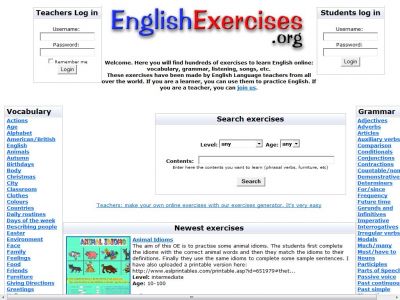
EnglishExercises.org, a web page whereyou will find hundreds of exercises to learn English online: vocabulary, grammar, listening, songs, etc.These exercises have been made by English Language teachers from all over the world. If you are a learner, you can use them to practice English. If you are a teacher, you can use them in your classes.