EE.OO.II SAMPLE TESTS
Here you have some EE.OO.II sample tests:
Castilla La Mancha EE.OO.II Tests
(Galician sample tests in this article)

Here you have some EE.OO.II sample tests:
Castilla La Mancha EE.OO.II Tests
(Galician sample tests in this article)
Some adjectives need a preposition before their object.
Here are some of the most common ones:
Click here to do an exercise.
MORE ADJECTIVES +PREPOSITIONS and another exercise. Here another two ones.
| Tense | Subject | Verb | Object | |
|---|---|---|---|---|
| Simple Present | Active: | Rita | writes | a letter. |
| Passive: | A letter | is written | by Rita. | |
| Simple Past | Active: | Rita | wrote | a letter. |
| Passive: | A letter | was written | by Rita. | |
When rewriting active sentences in passive voice, note the following:
Passive Voice Exercises :
Present Simple.(Click HERE as well)
Past Simple.( Click HERE as well)
funnylessons.com is a website that allows you to learn English through jokes.
An easy, fun English course. You can learn the language through jokes and the challenge is twofold. You have to understand English and also the punch line.
Each lesson has vocabulary, pronunciation, etc.. In addition, other materials are available in "more resources".
My 4th year ESO students are reading and abridged version of Romeo and Juliet (click here, too), by William Shakespeare.
Here you have flashcards with questions about Romeo and Juliet. (Here some more questions and answers).
Here they have the time line of Shakespeare’s life.Here, his plays.
Here, Shakespeare’s quotations and scripts and here, Shakespeare challenges.
Here you can discover Shakespeare’s world (Here you have information about Queen Elizabeth I ).
Here Romeo and Juliet test.
Here ten curious facts about Shakespeare.
Listen to your teacher and answer these questions.
HERE a few questions about Shakespeare.
ENJOY SHAKESPEARE!!!!!!!!!
Here are some ways in which we can give give advice or make recommendations.
Click here to listen to and watch an explanation on the use of should, ought to and had better provided by teacher Alex.
Here you have some exercises.
My 4th year C ESO students have Music as one of their optional subjects. In their Music classes they play instruments, sing, dance and of course learn about the history of music.
One of the songs they have to sing during the third term is "Do you hear the people sing?", from the amazing musical play "Les Misérables". Their music teacher intends to ask them to sing the song in English, so he has asked me to help them with the pronunciation and to translate the song into Spanish. I love "Les Misérables", in fact I have recently seen the musical in Madrid( click here, here and here) and I was astonished....The superb voices, the production..... Incredible!!!!!!!!!! In fact, the novel on which it is based, "Les Misérables", by Victor Hugo, is a masterpiece.
Here you have the lyrics.
Other famous songs from "Les Misérables":
If we report what another person has said, we usually do not use the speaker’s exact words (direct speech), but reported (indirect) speech. Therefore, you need to learn how to transform direct speech into reported speech. The structure is a little different depending on whether you want to transform a statement, question or request.
Exercise (statements) - Exercise (questions) - Exercise (requests) - Exercise (mixed)
Listen to statements in direct and reported speech -> Click HERE.
Listen to questions in direct and reported speech -> Click HERE.
The second conditional (also called conditional type 2) is a structure used for talking about unreal situations in the present or in the future.
Like a first conditional, a second conditional sentence consists of two clauses, an "if" clause and a main clause:
| if clause | main clause |
| If I had a million dollars, | I would buy a big house. |
If the "if" clause comes first, a comma is usually used. If the "if" clause comes second, there is no need for a comma:
| main clause | if clause |
| I would buy a big house | if I had a million dollars. |
We use different verb forms in each part of a second conditional:
| if clause | if + subject + simple past verb* |
| main clause | subject + would + verb |
*Note that this "simple past" form is slightly different from usual in the case of the verb BE. Whatever the subject, the verb form is "were", not "was": If I were rich, I’d buy a big house.
If you had a million dollars, what would you do? http://www.genkienglish.net/milliondollars.htm
If I had a million dollars (Fill in the gaps) http://www.helping-you-learn-english.com/second-conditional.html
ANOTHER SECOND CONDITIONAL SONG: iF i WERE A BOY - BY BEYONCE
First Conditional - (Type I)
If clause | Main clause |
If + Present tense | will / can / may / must/ + verb ///or imperative |
If it rains today, | I’ll stay at home |
· If he is busy now, I will come back tomorrow.
· If I have time, I’ll visit my parents this afternoon.
· If it is warm tomorrow, we’ll go to the beach.
· If it is cold, you must wear warm clothes.
· If he doesn’t do his homework, he won’t go to the party.
Click HERE, HERE, HERE, HERE and HERE for some practice. Click HERE to listen to some first conditional sentences.
Oxford, The City of Dreaming Spires, is famous all over the world for its University and place in history. For over 800 years, it has been a home to royalty and scholars, and since the 9th century an established town, although people are known to have lived in the area for thousands of years.
Oxford and Oxfordshire make an excellent destination ... Explore Oxfordshire’s varied landscape, visitor attractions and rural heritage or experience walking trails and cycling routes which show you all the hidden treasures here.
Renowned for its history and heritage, exquisite architecture, and ancient University, Oxford sits at the very heart of this rural county.
It’s easy to visit Oxfordshire; Oxford is just 50 minutes from central London by train or 90 minutes by frequent bus services. Once here, you can visit much of Oxfordshire by public transport including many of the county’s picturesque towns and villages.
Cambridge is located about 60 miles (100 Km) from London. Its university was founded in the twelfth century by disaffected academics from Oxford University. The oldest building from that time is in St John’s College but the oldest surviving college is Peterhouse. Cambridge and Oxford are similar distances from London: Oxford lies to the west and Cambridge to the north.
Cambridge a city for all seasons...
Be inspired by the many beautiful museums and art galleries. Admire the beautiful architecture and majestic college buildings.
Explore quaint passages set around the historic market place and colleges, where a unique and relaxing shopping experience can be found. Here a blend of independent shops is mingled with high street brands.
Relax in the many beautiful pubs, restaurants and cafes....
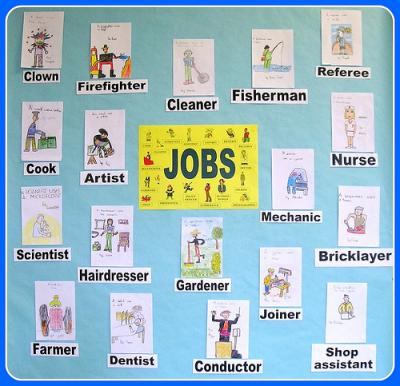
Click here to learn vocabulary and useful questions and expressions.
This is a crossword. Click here to do a reading comprehension exercise about a job interview. This is a vocabulary test.This is another vocabulary activity (you have to solve the randomly scrambled letters of the words/phrases (all from jobs )).Finally, click here and here to watch videos.
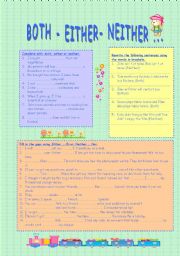
Both … and
Subjects connected by ’both … and’ take the a plural conjugation.
Examples:
Both Alice and Janice attended USC.
Both Jim and Peter are attending the conference in New York this weekend.
Either … or
’Either … or’ is used in sentences in a positive sense meaning "one or the other, this or that, he or she, etc." Verb conjugation depends on the subject (singular or plural) closest to the conjugated verb.
Examples:
Either Peter or the girls need to attend the course. (second subject plural)
Either Jane or Matt is going to visit next weekend. (second subject singular)
Neither … nor
’Neither … nor’ is used in sentences in a negative sense meaning "not this one nor the other, not this nor that, not he nor she, etc.". Verb conjugation depends on the subject (singular or plural) closest to the conjugated verb.
Examples:
Neither Frank nor Lilly lives in Eugene. (second subject singular)
Neither Axel nor my other friends care about their future. (second subject plural)
The Lost Thing is an amazing picture book by the wonderful artist Shaun Tan which has recently become a beautiful short film (click here as well). Have you ever felt as if you were some kind of weirdo? If your answer is "yes", it won’t be hard for you to understand what the short film above is about. Enjoy it!!!!!!
Click HERE for a fill-in-the-gaps exercise. Click HERE as well.
This is the first documentary BBC Human Planet has broadcast this season. What a risky job!!! Daredevil Galician barnacle-collectors defy death on the rocks for a catch worth 200 pounds per kilo.
http://www.mansioningles.com :
Grammar, Vocabulary, graded listening comprehension activities, exercises (quizzes, vocabulary, readings...), Rick Mansworth's adventures (Here you follow the exciting adventures of Rick Mansworth, Private Detective as he fights evil and saves the world. Each episode practises a different aspect of the language), books, videos(in their youtube channel).......
Grammar, tests, dictionaries, phonetics, listening comprehension activities, songs, books, games..... and much more.
If you are learning English, visit http://www.ompersonal.com.ar/
Everything is there for you to practise your English!
Look at the presentation above and then click here, here, here and here to do some exercises on the use of WILL or BE GOING TO (+infinitive).
Wlingua is an excellent English course. Improve your grammar, listening, reading comprehension, vocabulary, phonetics... (Click here). You can do the test, find out what your level is... and start your lessons. Try it!!